Cubism was a new wave art movement led by Pablo Picasso and Georges Braque, the revolutionaries of European's painting and statutory of the 20th century, who also influenced related movements in literature, architechture and music. In cubism, objects are being broken up, scrutinized and reformed in a complex manner. While rather than portraying an object from a single viewpoint, artist normally portray from several different viewpoints to display the object in a more tremendous background. It is usually done by intersecting at random angles in order to cross out logical sense of depth, while background and object planes merge each other to form shallow obscure space.
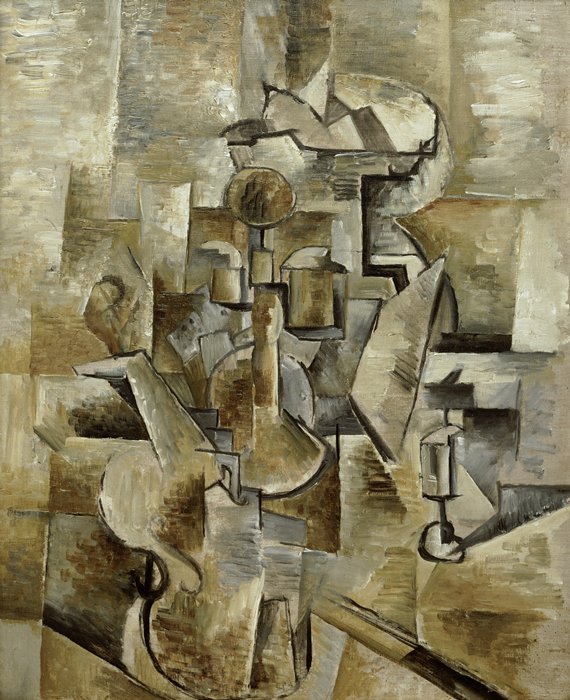

objects are being broken up, scrutinized and reformed in a complex manner...
History of cubism is analyzed in terms of phases. In one scheme, the first branch of cubism was known as "Analytic Cubism", which was both extreme and convincing as a short yet symbolic movement of art between 1907 and 1911 in France. It was done by introducing certain specific shapes or characteristic details that would represent the whole object or person, yet it is not an abstract art.

Analytic Cubism
Followed by "Synthetic Cubism" as the second phase, the movement was widely spread and then remained essential until around 1919, when the Surrealist movement gained its popularity. In Synthetic Cubism, real pieces of paper replaced painted flat depictions of paper. Real scores of music replaced drawn musical notation. Fragments of newspaper, playing cards, cigarette packs, and advertisements that were either real or painted interacted on the flat plane of the canvas as the artists tried to achieve a total interpenetration of life and art.

Synthetic Cubism
About Picasso Pablo:

Pablo Picasso
- born in Malaga on October 25, 1881 the son of the painter and drawing teacher
- attends the Art Academy La Lonja in Barcelona in 1895,
- travels to Paris in 1900, where he has his first one-man show with Ambroise Vollard.
- marriages Jacqueline Roque in 1961.
- attends the Art Academy La Lonja in Barcelona in 1895,
- travels to Paris in 1900, where he has his first one-man show with Ambroise Vollard.
- marriages Jacqueline Roque in 1961.
- dies in Mougins on April 8, 1973.
The Museo Picasso is opened in Barcelona as early as in 1963.
Elements of Design Analysis:

The Old Guitarist
Every single element in The Old Guitarist was carefully chosen to render a stronger reaction in the audience. For example, the monochromatic color scheme eliminates the joy of changing colors and light and creates flat, two-dimensional forms that dissociate the guitarist from time and place. In addition, the overall muted blue palette creates a general tone of melancholy and accentuates a tragic and sorrowful theme. Also, the sole use of oil on panel causes a darker and more theatrical mood. Oil tends to blend the colors together without losing the colors’ brightness, creating an even more cohesive dramatic composition.
Furthermore, the guitarist shows no sign of life and appears to be close to death, implying little comfort in the world and accentuating the misery of his situation. Details are eliminated and scale is manipulated to create elongated, scrawny, and elegant proportions and to intensify the silent contemplation of the guitarist and a sense of spirituality. Despite the guitarist’s blindness, viewers feel the guitarist holds an inner vision and psyche. Moreover, the large, brown guitar is the only shift in color found in the painting. The guitar fills up the space around the guitarist physically and symbolically. In its dull brown, the guitar becomes so prominent against the blue background that it is the center and focus of the guitarist and the viewer. The guitar comes to represent the guitarist’s world and only hope for survival.
This blind and poor artist depends on his guitar and the small fare he can create from his music for survival. Plus, a guitar, as a musical instrument, is a natural mean for expressing emotions. This allows the guitarist to share and increase his loneliness. Some art historians believe this painting expresses the solitary life of an artist and the natural struggles that come with the career. Therefore, music, or art, becomes a burden and a separating force, isolating artists from the rest of the world. Art in general becomes a symbol of rejection and isolation. And yet, despite the isolation, the guitarist (artist) depends on the rest of society for survival. All of these latter feelings and emotions reflect Picasso’s predicament at the time, which could easily lead to the conclusion that Picasso was criticizing the state of society. The Old Guitarist becomes an allegory of human existence.
Principles of Designs Analysis:
The principle of Pablo Picasso in The Old Guitarist, is mainly about using high contrast, for example, the fair skin and the dark robe. There are also hierarchy, in which the shadow on skin and corners have obvious differences. Furthermore, unity can also be seen throughout the whole picture, that is, the picture is more to blue colour in major, showing that the artist was trying to express depressive, sadness, and doom.

No comments:
Post a Comment