Thursday, 19 January 2012

Pablo Picasso's Cubism

January 20th 2012, Friday...


Cubism was a new wave art movement led by Pablo Picasso and Georges Braque, the revolutionaries of European's painting and statutory of the 20th century, who also influenced related movements in literature, architechture and music. In cubism, objects are being broken up, scrutinized and reformed in a complex manner. While rather than portraying an object from a single viewpoint, artist normally portray from several different viewpoints to display the object in a more tremendous background. It is usually done by intersecting at random angles in order to cross out logical sense of depth, while background and object planes merge each other to form shallow obscure space.
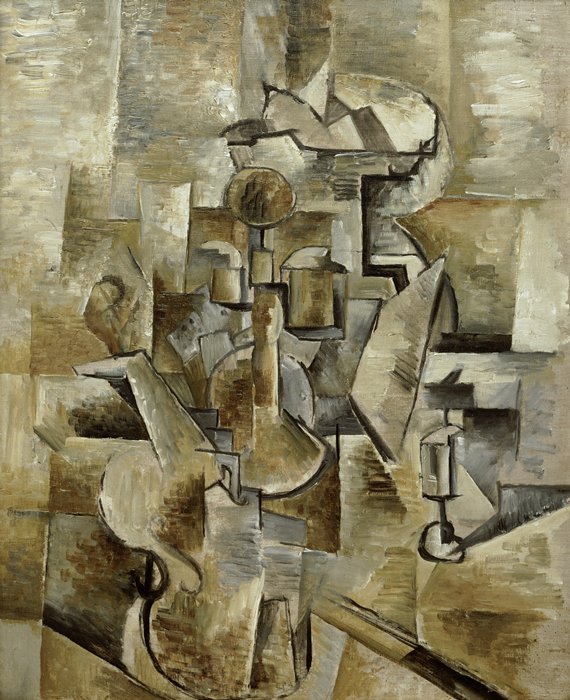

objects are being broken up, scrutinized and reformed in a complex manner...


History of cubism is analyzed in terms of phases. In one scheme, the first branch of cubism was known as "Analytic Cubism", which was both extreme and convincing as a short yet symbolic movement of art between 1907 and 1911 in France. It was done by introducing certain specific shapes or characteristic details that would represent the whole object or person, yet it is not an abstract art.
Analytic Cubism


Followed by "Synthetic Cubism" as the second phase, the movement was widely spread and then remained essential until around 1919, when the Surrealist movement gained its popularity. In Synthetic Cubism, real pieces of paper replaced painted flat depictions of paper. Real scores of music replaced drawn musical notation. Fragments of newspaper, playing cards, cigarette packs, and advertisements that were either real or painted interacted on the flat plane of the canvas as the artists tried to achieve a total interpenetration of life and art.

Synthetic Cubism

About Picasso Pablo:


Pablo Picasso

- born in Malaga on October 25, 1881 the son of the painter and drawing teacher
- attends the Art Academy La Lonja in Barcelona in 1895,
- travels to Paris in 1900, where he has his first one-man show with Ambroise Vollard.
- marriages Jacqueline Roque in 1961. 
- dies in Mougins on April 8, 1973.

The Museo Picasso is opened in Barcelona as early as in 1963. 


Elements of Design Analysis:
The Old Guitarist

Every single element in The Old Guitarist was carefully chosen to render a stronger reaction in the audience. For example, the monochromatic color scheme eliminates the joy of changing colors and light and creates flat, two-dimensional forms that dissociate the guitarist from time and place. In addition, the overall muted blue palette creates a general tone of melancholy and accentuates a tragic and sorrowful theme. Also, the sole use of oil on panel causes a darker and more theatrical mood. Oil tends to blend the colors together without losing the colors’ brightness, creating an even more cohesive dramatic composition.

Furthermore, the guitarist shows no sign of life and appears to be close to death, implying little comfort in the world and accentuating the misery of his situation. Details are eliminated and scale is manipulated to create elongated, scrawny, and elegant proportions and to intensify the silent contemplation of the guitarist and a sense of spirituality. Despite the guitarist’s blindness, viewers feel the guitarist holds an inner vision and psyche. Moreover, the large, brown guitar is the only shift in color found in the painting. The guitar fills up the space around the guitarist physically and symbolically. In its dull brown, the guitar becomes so prominent against the blue background that it is the center and focus of the guitarist and the viewer. The guitar comes to represent the guitarist’s world and only hope for survival.

This blind and poor artist depends on his guitar and the small fare he can create from his music for survival. Plus, a guitar, as a musical instrument, is a natural mean for expressing emotions. This allows the guitarist to share and increase his loneliness. Some art historians believe this painting expresses the solitary life of an artist and the natural struggles that come with the career. Therefore, music, or art, becomes a burden and a separating force, isolating artists from the rest of the world. Art in general becomes a symbol of rejection and isolation. And yet, despite the isolation, the guitarist (artist) depends on the rest of society for survival. All of these latter feelings and emotions reflect Picasso’s predicament at the time, which could easily lead to the conclusion that Picasso was criticizing the state of society. The Old Guitarist becomes an allegory of human existence.

Principles of Designs Analysis:

The principle of Pablo Picasso in The Old Guitarist, is mainly about using high contrast, for example, the fair skin and the dark robe. There are also hierarchy, in which the shadow on skin and corners have obvious differences. Furthermore, unity can also be seen throughout the whole picture, that is, the picture is more to blue colour in major, showing that the artist was trying to express depressive, sadness, and doom. 

Saturday, 14 January 2012

Art Movement

January 15th 2012, Sunday...

Art movement, is a trend, norm, or style of art that is popular at a specific time that a group of artists follow in that period of time. It was especially important to modern art, where each subsequent movement was considered as a new generation, technically known as "avant-garde", and was normally a phenomenon of western art.

Causes of movement include, the changes of culture due to different generations, where artists' thinking changed their expressions or visual communications and thus lead to the changes of trend. Also, different style and understanding from various artists would also cause movement to art. Just like music, where movements are commonly referred to as "genre". Baroque music is different from classical music. People from in classical music era would wanna change from baroque style to classical because baroque was no longer the trend. Perhaps classical artists like Beethoven and Mozart were also better than previous composers. Thus, they became the trend.

There are some examples of art movements directly from Wikipedia:


Surrealism is a cultural movement that began in the early 1920s, and is best known for the visual artworks and writings of the group members.
Surrealist works feature the element of surprise, unexpected juxtapositions and non sequitur; however, many Surrealist artists and writers regard their work as an expression of the philosophical movement first and foremost, with the works being an artifact. Leader André Breton was explicit in his assertion that Surrealism was above all a revolutionary movement.
Surrealism developed out of the Dada activities during World War I and the most important center of the movement was Paris. From the 1920s onward, the movement spread around the globe, eventually affecting the visual arts, literature, film, and music of many countries and languages, as well as political thought and practice, philosophy, and social theory.

Regionalism is an American realist modern art movement that was popular during the 1930s. The artistic focus was from artists who shunned city life, and rapidly developing technological advances, to create scenes of rural life. Regionalist style was at its height from 1930 to 1935, and is best-known through the so-called "Regionalist Triumvirate" of Grant Wood in Iowa, Thomas Hart Benton in Missouri, and John Steuart Curry in Kansas. During the Great Depressionof the 1930s, Regionalist art was widely appreciated for its reassuring images of the American heartland

Social Realism, also known as Socio-Realism, is an artistic movement, expressed in the visual and other realist arts, which depicts social and racial injustice, economic hardship, through unvarnished pictures of life's struggles; often depicting working class activities as heroic. The movement is a style of painting in which the scenes depicted typically convey a message of social or political protest edged with satire. This is not to be confused with Socialist Realism, the official USSR art form that was institutionalized by Joseph Stalin in 1934 and later allied Communist parties worldwide

Friday, 13 January 2012

Perceptual Vs. Conceptual Drawings

January 14th 2012, Sat...

What is drawing? Simply picking a pencil and sketch an object on a paper? Yes, but how is it done? I'm sure people, or even artists have always done drawing unconsciously. Try to spend sometime thinking, and you will discover that drawing actually involves visuals and thoughts. We draw something when we see or think of it. In this case, drawing is then conceptual and perceptual.


Drawing & seeing the object simultaneously...

About perceptual, it is senses, visuals; what we saw. When drawing is referred to as perceptual, it most probably means an artist responding immediately to the experience of seeing and scribbling simultaneously. For example, sketch artist who work fast with their eyes flickering between paper and live subject are drawing perceptually. Normally, amateur or beginner drawers would draw perceptually due to the lack of experiences and techniques. When they learn through drawing something by seeing and sketching at the same time, perceptual drawing is done.

Think and draw...

Whereby, conceptual drawing is about thoughts or getting the concepts. In this method, artists sketch something relied only on what is in their minds. An artist who is looking at what they're drawing for more than a few seconds is drawing conceptually. Also, when the artist digests a scene and later render large chunks of that scene at a time, it's conceptual. Conceptual drawing normally occur in experienced artists when they are asked to sketch something they seen some time ago, they then will get the big picture of the scene and draw what they remember.

Both methods have their cons and pros. For perceptual, some people might argue that, pictures drawn should be at most accurate and nearest to the original subject and therefore perceptual is more practical. However, perceptual drawing can never help further improving even it illustrates how clearly the artist is thinking and captures the artist's experience of perceiving a  subject. While in conceptual drawing, results may not be as accurate as perceptual since human brain has it's limit, but practising conceptual drawing allows the brain to be more creative because it has the whole picture of any subject that is told to be drawn.


Personally, I recommend more on conceptual drawing. It is true that the result might not be accurate as perceptual drawing as the original subject, but there's no creative art looks exactly the same in the world of art and design. In order to be creative, art and drawing should go conceptual. Getting the big picture or rough idea in the mind and create something new is always the principle of art.


Thanks for reading :)
Kyuo,
The Dynamic Kid.

Wednesday, 11 January 2012

Something About Myself ^^

January 11th 2012, Wed...

Good day folk :) It's my very first post to this blog that dedicated to my course, HAA102 Intro to Design. You are gonna be so lucky to see my epic design, so stay tuned ya. Today I'm gonna start off with some introduction about myself, some personal backgrounds, future career and wish list.

My name is Chua Jien Yang, or most of my friend called me Kyuo (pronounced Q + O), don't be surprise I'm still a 100% local, it's just my name (Jien Yang) in Cantonese or Japanese (Ken + Yuo). I guess it's special enough for you to remember ;) I'm from Puncak Jalil, Seri Kembangan and my birthday is 15th Apr 1989.

I was studying in SJKC Chen Moh primary school at Petaling Jaya and later proceeded to Phileo Resource Center for home schooling as secondary studies. Due to a terrible English foundation, I took 8 years to finish my highschool syllabus, which explains why I'm latter by years in degree. In 2011, I entered Taylor's College Subang Jaya for my Pre-U programme South Australian Matriculation (SAM), subjects included: Legal Studies, Economics, Psychology, Accounting and Research Projects. Thanks to all the hard works and results that enable me to proceed to higher degree studies in HELP University College in 2012. I'm now majoring in Bachelor of Communication (Media Studies) (Hons).

I'm an extremely outgoing person. I love to be dynamic, active and lively. Choosing Mass Communication as degree studies, I wish my future career will be more enjoyable, perhaps as a DJ, media director, film maker or photographer. Those are my interests, I can be passionate on them and therefore I believe, a job can be well done if it is already an inbuilt interest. I hope Mass Communication can help me to achieve and equip me with good capabilities for my future career. 

This round, I hope I can learn how to be more creative and think out of the box with the studies of Intro to Design, as it needs us to do much sketches and drawings in various ways. I wish to improve myself through trial and error, thus becoming more capable of challenges if ever I enroll in advertising or design fields. Praying hard for an all the best to myself and my lecturer Deepak Menon as well.


Kyuo
The Dynamic Kid :)