Sunday, 1 April 2012

3 Holy Epic Choices

1st April 2012, Sunday...

After struggling for the many wonderful sketches that I've drawn, it reaches almost the final stage of the production. Through the evaluation and appreciated suggestions of my lecturer Mr. Deepak, 3 among the 18 choices were being chosen for PhotoShop refining. I'm about to present you the Moon Light Rose, The Jack and The Bean's House, and Tree On a Silent Hill.

Series: Environmentalism
Reference Artist: Pablo Picasso
Art Movement: Cubism


First of all, I went to "Image" and selected "Adjustment" to balance my sketch's contrast and exposure.

Next, I used the Magic Wank Tool located at the side tool bar to select the areas that I wanted to apply colours and effect. I used it interchangeably with Quick Selection so that over spilled parts can be controlled easily.
In order to colour the clouds, I used Quick Selection Tool to select the clouds first, then click on the brush icon located right besides the colour pad. Scrolled down to size 39px in brush preset and selected it, which allows me to create haze-like effect for the clouds.

Next, I used Magic Wank Tool in the size of 30px to select the grassland area that I wanted to fill up with colour as shown in the screenshot above. Colour chosen: Light Green Tea Colour.

Followed up by the larger grassland area, I reused the same method but carefully avoided from selecting the stem part of the rose. Colour chosen: Standard Green.

Later on, I assessed to brush presets again to select size 112px grass-like brush tool. By setting the colour combinations of green and dark blue, it provided grass-like effect for the grassland.

Finally, when all the important parts were being done, I then selected the rest of the areas with Magic Wank Tool and Quick Selection Tool so that I can fill them up with all the colours I've planned ^^


The Moon Light Rose

Elements of Design: Every element in The Moon Light Rose was being chosen carefully to render mysterious feelings in the audience. For example, the purple colour of the sky, which represents midnight. Most mysterious themes like, wolves turning into werewolves, vampires awakening, or the dead walk the earth always seem to happen during the mid of darkness. Cloudy full moon; full moon is always an omen of something bad or evil, say the transformation of werewolves, or devils often base on the full moon night to start something. The clouds, which are about to cover the moon in the picture, shows that the last source of lighting is disappearing, something's going to happen before the last beam of light from the moon ended. The dark red rose, in which the characteristics of elegance and mysterious make up the absolute enigmatic feel. Outstanding itself on the grassland, and it's own shadow from the moon light make it looks extreme lonely, thus strengthening its mysteriousness.

Principles of Design Analysis: The principle in drawing The Moon Light Rose, is mainly about using fairly high contrast, for example, the green grassland and the red rose. There are also hierarchies, in which the shadows of the grassland, mountain cliff side and the corner of the rose have obvious differences. Furthermore, unity can also be seen throughout the whole picture, that is, the picture is more to dark green and purple colours in major, showing that the picture was trying to express mysterious, enigmatic and abstruse


First of all, select the roof area with Magic Wank Tool and Quick Selection Tool and choose round brush shape. Colour chosen: Sky blue.

Next, used the same tools to select the bricks part. I've again used them interchangeably to avoid over spill parts. Also, used Quick Selection Tool to deselect some of the bricks so that later can fill these deselected bricks with dark green colour. Colours chosen for the wall: Violet & Light Purple. 


By deciding the colour for the parts earlier on, I fill them up simultaneously after selecting them using Magic Wank Tool and Quick Selection Tool. They are the wall parts without bricks. Colour chosen: Bright Yellow.

Parts like unseen angles, staircases, and walls are being differentiated by colours such as, unseen angles in dark blue, staircases in lighter and lightest blue and some purple colour walls.

Followed up by the most front part objects, which is the huge fencing part of the house, was being selected using Magic Wank Tool and the different parts were being differentiated between green and blue colour.

Lastly, the sky was being separated by different colours to show the fore and back of the hierarchies.
Colours chosen: Light Blue and Deep Sea Blue.


The Jack & The Bean's House

Elements of Design: The entire picture of The Jack & The Bean's House mostly using dark colouring, that is the dark blue to show the mysteriousness of the giant house. From the viewpoint of a normal size human, there will most likely to have some angles of this big house that normal size human can't see. Those are the areas represented by the darker blue colour, causing people to wonder what it be. Green moss bricks shows that the house hasn't been maintaining well, this would only occur when there's an eccentric owner. Huge staircase that leads only the wall, makes people wondering why is there a staircase without an entrance after it. Eventually, the dark sky shown in the dark blue colour once again associating the scariness of such mysteriously big, sombre, and overcast house.

 Principles of Design Analysis: High colour contrast is also being used in some parts of the house separating different walls. As in term of hierarchies, colours of the sky are being differentiated between darker and lighter blue, showing the fore and back, as well as the bricks of the house in lighter and darker purple. Also, lower bottom of the picture shows the nearest objects, which were being stood out by using lighter green and blue colours. While in unity, this picture too, is using dark blue as the major colour to show gloomy, and scariness of this big mysterious house.


Firstly, due to the round part of the leaves. I've used the Quick Selection Tool to select the area that I wanted to separate so that different colours for the leaves part can be applied. This method provided the effect of deep and light green colours often appear on the tree. Colour chosen: Leaves Green and Dark Green

 In order to show the different parts of the tree trunk, it was being divided into somewhat equal parts where grey and brown colours were chosen to dominate it.

Colours of the whole picture were planned to be equally distributed, so that the picture will look more balance. Hence, similar colours were being chosen for the hills and the soil at the hill side. Magic Wank and Quick Selection Tools were well managed as there wasn't any over spill parts. Colour chosen: Light, Medium, and Dark Brown for the hill side soil; Sparkling Green and Dark Green for hills.

Finally, in order for the secretive feel to be reviewed, I assessed to the brush presets, scrolled down and selected pedal-like brush in size 96px to create the fog-like effect for the background.


Tree On A Silent Hill

Elements of Design: Elements chosen in this Tree On A Silent Hill too, based on a mysterious theme or style. First of all, only one tree chosen to be shown in the entire picture. This enhances the feel of lonely and emotional, which in turn associates with the tone of mysterious. The tree grows at the end of the hill side, partly portraying that hope ended. The leaves of the tree are slanted towards a single side, telling that most probably wind is often only blow from one direction to the other. But a silent hill doesn't seem to be possible to have such strong wind, which then would make people wonder for the reason. Lastly, foggy background which contain the feel of secretive as fog usually can hardly be seen through, thus, making possible for hiding.

Principles of Design Analysis: The colours of dark brown, grey, and green made up the high colour contrast that is relevant to the style of the reference artist that I've chosen, Pablo Picasso. As in hierarchies, light green and dark green made up the fore and back of the leaves and hill sides, light brown and dark brown made up the different layers of soil and bright light blue made the landscape mountain from far. Overall, major colour of the picture lies in dark and vague colour like grey and green to show the enigmatic and lonely silent expression.

Wednesday, 22 February 2012

18 Sketches

Series: Environmentalism
Reference Artist: Pablo Picasso
Art Movement: Cubism

Introduction
I chose environmentalism as my art series, because environmentalism covers a large area of what revolves around the world and has always been there. The wonders of nature has wide definitions and meanings that cause different people to feel differently. Therefore, I hope my sketches would tell most of the words in my mind. They review what I think.

Problem Statement
The problem that I faced while sketching was the miss-match between fine art and the art movement that I chose, Cubism. This happened because things that I interact with daily used not to be in Cubism, thus it would be quite a tough task to express my thoughts all in Cubism. Sometimes they would lean toward fine art unintentionally.

Purpose of Content
Mysterious and enigma are the main dominant of my arts. They'll never tell the whole story but instead, they allow you to further your imaginations.

Research Question
What is hiding behind all the mysterious scenes?
Are they just what they are physically?
Or they were there to take care of some hidden answers?

Houses at the top of the Caves of Matera.
A place where all the houses arranged in a chaotic way, where the different types of people staying in. Seemingly peaceful but danger might be in its dominant as well.

Pyramid and the Sphinx in the desert.
Pyramid, Sphinx and desert always have something to do with death. That's what the Egyptian happens to believe since thousands of years ago. Are these things just plain statues, or they actually have the supernatural power in linking to the other world?

Moving Castle
Castles are known to be built permanently in a fixed place. But a moving castle would be fairly unimaginable, not only in the purpose, but also the unbelievable moving ability. Who would build such impossible castle and how long it takes to do so?

The Great Wall of China
What we always see, is just the "come-into-being" Great Wall of China. But who will ever think how long and how many man-power it took to get this wall done?? How was it possible for ancient people in China to build such amazing thing that even today's technology would face a challenge?

Moai Statues on Easter Island.
Moai Statues on the Easter Island leave a big question mark to the world, that even well known archaeologists couldn't define what they mean, how they were formed, and who made them..

Tree on a silent hill.
A tree appear on a silent hill, where it's windless, yet what causes the tree to slant towards one side instead of holding up straight?  

Dangling spiral staircase
A spiral staircase dangling in between the sky and the ground. Without a starting and ending part, who actually happens to be possible to build such staircase in the middle of the air? Does it mean something behind? Or it's being shifted from a different warped dimension?

Endless Journey
A railroad appears in the midst a rural forest. The first thing comes to mind is, where will this railroad extends to? It would be great to tag along on this endless journey and explore about it. 

Moon Light Rose
Rose is vivid in red and is used to stand for beauty and elegance most of the time. But rose that appears under  moon light would stand more for silent, doom, depress, and creepy due to the dark red color. Something's gonna happen before the last beam of light from the moon ends?

The Jack and The Bean's House
Why could there be such a giant house? Does The Jack and The Bean really occur? Human that is a hundred times bigger than us? Or it too means that human that are a hundred times smaller than us occur too?

The Red Maple Leaves
Maple leaves are special, instead of turning into yellow in the season of Autumn, it turns red. What could it mean to stand out from the others? Simple more special, or there's a story behind it?

Which Way? Heaven or Hell??
Which way would be the best? Heaven or hell? Is there really such ways to choose from or fate decides everything in advance? 

Inverted Pyramid
Pyramid will never be possible in an inverted or upside down form. Thus, could this be a mirage? Or again, it was being shifted from a warped dimension? 

Wonderful Dreamland
A dream-like scene, what one would dream to have or visit. If it really a dream scene, what will all the things stand for? What is in the dreamer's mind that result in such a scene?

Original Earth Global Warming
Earth was thought to be a cube instead of sphere in the past. And therefore, there's this earth in it's "original" form being polluted and thinking of recycling. 

Desert Door and Frames
Doors and frames re something that shouldn't be appearing in the midst of the desert. Who would have set these door and frames up then? Or it was the warped dimension who actually shifted them here?

Bamboo In The Fog
In ancient China, bamboo forest often acted as the best place for the assassins to hide themselves up. You would know what's behind each of the shadow.

Thursday, 19 January 2012

Pablo Picasso's Cubism

January 20th 2012, Friday...


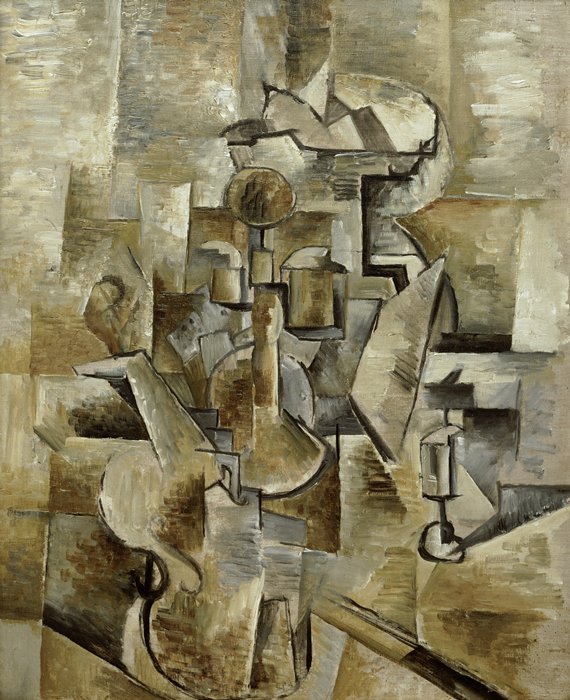
Cubism was a new wave art movement led by Pablo Picasso and Georges Braque, the revolutionaries of European's painting and statutory of the 20th century, who also influenced related movements in literature, architechture and music. In cubism, objects are being broken up, scrutinized and reformed in a complex manner. While rather than portraying an object from a single viewpoint, artist normally portray from several different viewpoints to display the object in a more tremendous background. It is usually done by intersecting at random angles in order to cross out logical sense of depth, while background and object planes merge each other to form shallow obscure space.


objects are being broken up, scrutinized and reformed in a complex manner...


History of cubism is analyzed in terms of phases. In one scheme, the first branch of cubism was known as "Analytic Cubism", which was both extreme and convincing as a short yet symbolic movement of art between 1907 and 1911 in France. It was done by introducing certain specific shapes or characteristic details that would represent the whole object or person, yet it is not an abstract art.
Analytic Cubism


Followed by "Synthetic Cubism" as the second phase, the movement was widely spread and then remained essential until around 1919, when the Surrealist movement gained its popularity. In Synthetic Cubism, real pieces of paper replaced painted flat depictions of paper. Real scores of music replaced drawn musical notation. Fragments of newspaper, playing cards, cigarette packs, and advertisements that were either real or painted interacted on the flat plane of the canvas as the artists tried to achieve a total interpenetration of life and art.

Synthetic Cubism

About Picasso Pablo:


Pablo Picasso

- born in Malaga on October 25, 1881 the son of the painter and drawing teacher
- attends the Art Academy La Lonja in Barcelona in 1895,
- travels to Paris in 1900, where he has his first one-man show with Ambroise Vollard.
- marriages Jacqueline Roque in 1961. 
- dies in Mougins on April 8, 1973.

The Museo Picasso is opened in Barcelona as early as in 1963. 


Elements of Design Analysis:
The Old Guitarist

Every single element in The Old Guitarist was carefully chosen to render a stronger reaction in the audience. For example, the monochromatic color scheme eliminates the joy of changing colors and light and creates flat, two-dimensional forms that dissociate the guitarist from time and place. In addition, the overall muted blue palette creates a general tone of melancholy and accentuates a tragic and sorrowful theme. Also, the sole use of oil on panel causes a darker and more theatrical mood. Oil tends to blend the colors together without losing the colors’ brightness, creating an even more cohesive dramatic composition.

Furthermore, the guitarist shows no sign of life and appears to be close to death, implying little comfort in the world and accentuating the misery of his situation. Details are eliminated and scale is manipulated to create elongated, scrawny, and elegant proportions and to intensify the silent contemplation of the guitarist and a sense of spirituality. Despite the guitarist’s blindness, viewers feel the guitarist holds an inner vision and psyche. Moreover, the large, brown guitar is the only shift in color found in the painting. The guitar fills up the space around the guitarist physically and symbolically. In its dull brown, the guitar becomes so prominent against the blue background that it is the center and focus of the guitarist and the viewer. The guitar comes to represent the guitarist’s world and only hope for survival.

This blind and poor artist depends on his guitar and the small fare he can create from his music for survival. Plus, a guitar, as a musical instrument, is a natural mean for expressing emotions. This allows the guitarist to share and increase his loneliness. Some art historians believe this painting expresses the solitary life of an artist and the natural struggles that come with the career. Therefore, music, or art, becomes a burden and a separating force, isolating artists from the rest of the world. Art in general becomes a symbol of rejection and isolation. And yet, despite the isolation, the guitarist (artist) depends on the rest of society for survival. All of these latter feelings and emotions reflect Picasso’s predicament at the time, which could easily lead to the conclusion that Picasso was criticizing the state of society. The Old Guitarist becomes an allegory of human existence.

Principles of Designs Analysis:

The principle of Pablo Picasso in The Old Guitarist, is mainly about using high contrast, for example, the fair skin and the dark robe. There are also hierarchy, in which the shadow on skin and corners have obvious differences. Furthermore, unity can also be seen throughout the whole picture, that is, the picture is more to blue colour in major, showing that the artist was trying to express depressive, sadness, and doom. 

Saturday, 14 January 2012

Art Movement

January 15th 2012, Sunday...

Art movement, is a trend, norm, or style of art that is popular at a specific time that a group of artists follow in that period of time. It was especially important to modern art, where each subsequent movement was considered as a new generation, technically known as "avant-garde", and was normally a phenomenon of western art.

Causes of movement include, the changes of culture due to different generations, where artists' thinking changed their expressions or visual communications and thus lead to the changes of trend. Also, different style and understanding from various artists would also cause movement to art. Just like music, where movements are commonly referred to as "genre". Baroque music is different from classical music. People from in classical music era would wanna change from baroque style to classical because baroque was no longer the trend. Perhaps classical artists like Beethoven and Mozart were also better than previous composers. Thus, they became the trend.

There are some examples of art movements directly from Wikipedia:


Surrealism is a cultural movement that began in the early 1920s, and is best known for the visual artworks and writings of the group members.
Surrealist works feature the element of surprise, unexpected juxtapositions and non sequitur; however, many Surrealist artists and writers regard their work as an expression of the philosophical movement first and foremost, with the works being an artifact. Leader André Breton was explicit in his assertion that Surrealism was above all a revolutionary movement.
Surrealism developed out of the Dada activities during World War I and the most important center of the movement was Paris. From the 1920s onward, the movement spread around the globe, eventually affecting the visual arts, literature, film, and music of many countries and languages, as well as political thought and practice, philosophy, and social theory.

Regionalism is an American realist modern art movement that was popular during the 1930s. The artistic focus was from artists who shunned city life, and rapidly developing technological advances, to create scenes of rural life. Regionalist style was at its height from 1930 to 1935, and is best-known through the so-called "Regionalist Triumvirate" of Grant Wood in Iowa, Thomas Hart Benton in Missouri, and John Steuart Curry in Kansas. During the Great Depressionof the 1930s, Regionalist art was widely appreciated for its reassuring images of the American heartland

Social Realism, also known as Socio-Realism, is an artistic movement, expressed in the visual and other realist arts, which depicts social and racial injustice, economic hardship, through unvarnished pictures of life's struggles; often depicting working class activities as heroic. The movement is a style of painting in which the scenes depicted typically convey a message of social or political protest edged with satire. This is not to be confused with Socialist Realism, the official USSR art form that was institutionalized by Joseph Stalin in 1934 and later allied Communist parties worldwide

Friday, 13 January 2012

Perceptual Vs. Conceptual Drawings

January 14th 2012, Sat...

What is drawing? Simply picking a pencil and sketch an object on a paper? Yes, but how is it done? I'm sure people, or even artists have always done drawing unconsciously. Try to spend sometime thinking, and you will discover that drawing actually involves visuals and thoughts. We draw something when we see or think of it. In this case, drawing is then conceptual and perceptual.


Drawing & seeing the object simultaneously...

About perceptual, it is senses, visuals; what we saw. When drawing is referred to as perceptual, it most probably means an artist responding immediately to the experience of seeing and scribbling simultaneously. For example, sketch artist who work fast with their eyes flickering between paper and live subject are drawing perceptually. Normally, amateur or beginner drawers would draw perceptually due to the lack of experiences and techniques. When they learn through drawing something by seeing and sketching at the same time, perceptual drawing is done.

Think and draw...

Whereby, conceptual drawing is about thoughts or getting the concepts. In this method, artists sketch something relied only on what is in their minds. An artist who is looking at what they're drawing for more than a few seconds is drawing conceptually. Also, when the artist digests a scene and later render large chunks of that scene at a time, it's conceptual. Conceptual drawing normally occur in experienced artists when they are asked to sketch something they seen some time ago, they then will get the big picture of the scene and draw what they remember.

Both methods have their cons and pros. For perceptual, some people might argue that, pictures drawn should be at most accurate and nearest to the original subject and therefore perceptual is more practical. However, perceptual drawing can never help further improving even it illustrates how clearly the artist is thinking and captures the artist's experience of perceiving a  subject. While in conceptual drawing, results may not be as accurate as perceptual since human brain has it's limit, but practising conceptual drawing allows the brain to be more creative because it has the whole picture of any subject that is told to be drawn.


Personally, I recommend more on conceptual drawing. It is true that the result might not be accurate as perceptual drawing as the original subject, but there's no creative art looks exactly the same in the world of art and design. In order to be creative, art and drawing should go conceptual. Getting the big picture or rough idea in the mind and create something new is always the principle of art.


Thanks for reading :)
Kyuo,
The Dynamic Kid.